SOS in Morse Code
SOS in Morse code is ... --- ..., three dots, three dashes and three dots. It is sent as one unbroken signal rather than three separate letters, which gives it a rhythm nothing else in Morse shares. It is the international distress call, and it works as sound, light or tapping.
Last updated:
What SOS looks like in Morse code
SOS is ... --- .... Read it as dit dit dit, dah dah dah, dit dit dit: nine signals in a short, long, short pattern that is symmetrical end to end.
| Word or phrase | Morse code |
|---|---|
| SOS | ... --- ... |
| HELP | .... . .-.. .--. |
| CQD | -.-. --.- -.. |
Help is the word most people try first. It is longer to send and has no special rhythm, which makes it easier to lose in noise.
CQD is the older distress call that SOS replaced. It is in the table because it still turns up in the Titanic story, which is told further down.
SOS ... --- ...
To hear it, play SOS in the Morse code translator and press Listen. Every code on this page comes from that same translator.
Why SOS is sent as one signal, not three letters
Written down, SOS looks like the letters S, O and S. Sent properly, it is a single character: the nine signals run together with only the short gap that normally sits inside a letter.
Operators call a character like this a procedural signal, or prosign. Written as one unbroken run, SOS is ...---....
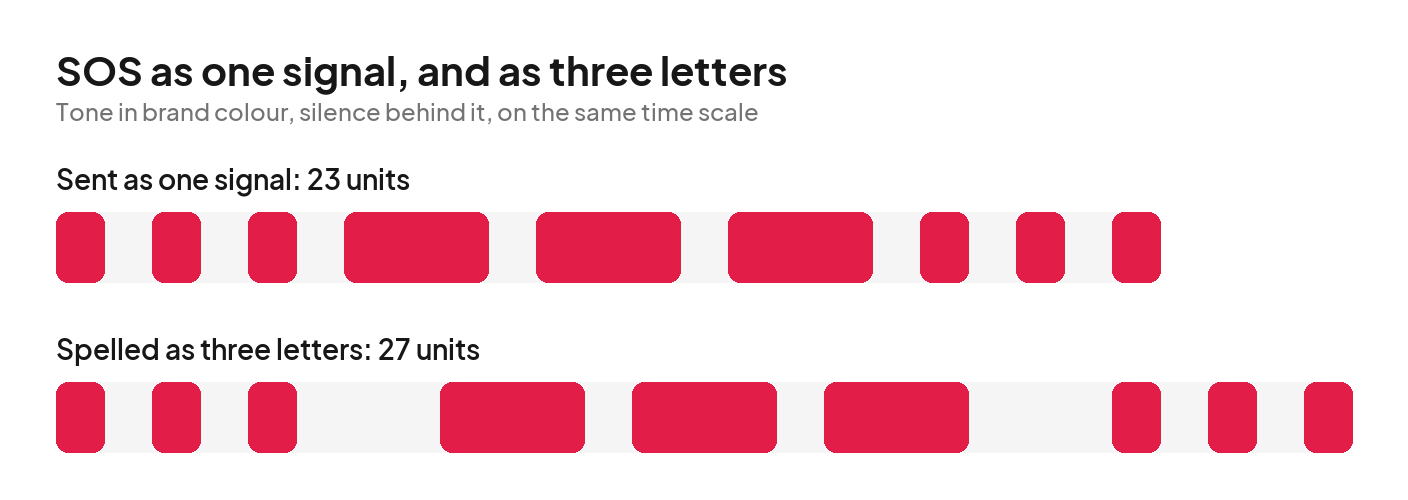
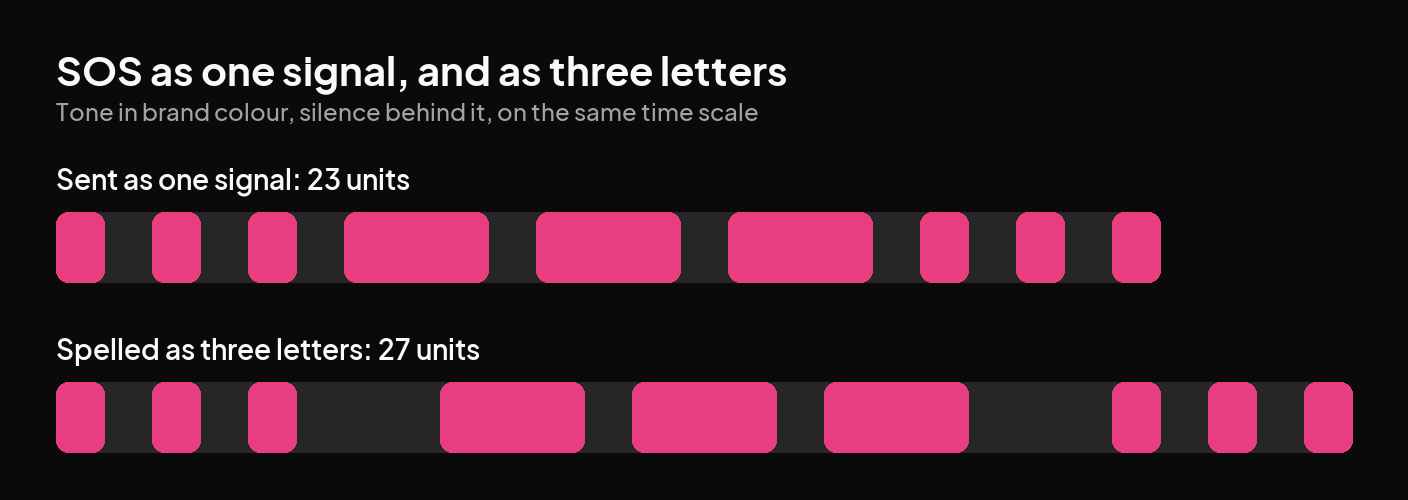
The difference is small but measurable. As one signal, SOS lasts 23 dot-lengths. Spelled as three letters, with the normal letter gaps, it lasts 27.
At 20 words per minute, a common operating speed, that is 1.38 seconds against 1.62. Either way, a listener still hears SOS.
The translator on this site writes SOS with spaces between the letters. That is deliberate: ...---... is not a character in the standard table, so the spaced version is the one any decoder can read back.
How to send SOS with a flashlight or light
Light uses exactly the same pattern as sound. A short flash is a dot and a long flash is a dash, and the long one should last about three times the short one.
A simple way to keep it even is to count. Hold each short flash for a count of one and each long flash for a count of three, with a count of one dark between flashes.
- Three short flashes.
- Three long flashes.
- Three short flashes.
- A long pause, then repeat the whole sequence.
The long pause between repeats matters as much as the flashes. It tells anyone watching where the message starts, so they do not read the end of one SOS into the start of the next.
How to tap or knock SOS
On a screen or a key, tapping works like a flashlight: press briefly for a dot and hold for a dash. The Morse code tapper lets you practise this and shows what each press decodes to.
Knocking on a wall or pipe is harder. A knock has no length, so you cannot hold it to make a dash. Anything you invent will only be understood by someone who already knows your system.
If a long signal is possible at all, a whistle, a horn or a light, use that instead of knocking. The pattern only works when dots and dashes can be told apart.
SOS with a whistle
A whistle can send SOS in Morse: three short blasts, three long ones, three short. Some hikers and mountain rescue groups teach a different signal, though: a set of long blasts repeated at intervals.
Neither one is wrong. If you are heading somewhere remote, check which signal the local rescue service uses, because a rescuer listening for one may not expect the other.
Why SOS became the distress signal
SOS was chosen for how it sounds, not for what it stands for. Save our souls and save our ship were both attached to it afterwards.
The International Radiotelegraphic Convention signed in Berlin in 1906 made SOS the international distress signal, and it came into force in 1908. Its symmetrical pattern is hard to mistake for anything else, even through static.
The Titanic is the reason most people know it. Its operators sent the older CQD in 1912 and then SOS as well. It was not the first SOS ever sent, but it is the one everyone remembers.
The longer history, including the rejected alternative and how the Titanic's calls went out, is in what Morse code is and where it came from.
Is SOS still used today?
Ships no longer rely on it. The Global Maritime Distress and Safety System replaced Morse distress calls at sea in 1999, with satellite beacons and digital radio alerts taking over.
The pattern itself has not gone anywhere. Three short, three long, three short is still understood almost everywhere as a call for help, whether it arrives as sound, light or marks on the ground.
The Emergency SOS feature on phones borrows the name only. It calls emergency services and shares your location. It does not send Morse code.
Signals that get mistaken for SOS
- Mayday is the spoken distress call, used over voice radio. It is not sent in Morse, and it has no dot and dash pattern of its own.
- CQD is the older Morse distress call, still in use by some operators in 1912. It was replaced by SOS.
- The old Nokia text message tone sounds like SOS to many people, but it spells SMS: ... -- .... The middle group is two dashes, not three.
Questions people ask about SOS in Morse code
What is SOS in Morse code?
SOS is ... --- ...: three dots, three dashes and three dots. It is sent as one continuous signal and is the international distress call.
What does SOS stand for?
Nothing. It is not an abbreviation of save our souls or save our ship. The letters were picked because their Morse pattern is short, symmetrical and easy to recognise.
Is SOS three letters or one?
Both, depending on how you look at it. It is written as S, O and S, but it is meant to be sent as a single character with no letter gaps inside it.
How long does it take to send SOS?
At 20 words per minute it takes about 1.38 seconds. By flashlight or by hand it is much slower, and that is fine. Even spacing matters more than speed.
Can I decode an SOS I recorded?
Yes. The Morse code audio translator decodes beeps from a recording or your microphone. For a flashing light on video, use the image and video translator.